
01
Get an AutoSprite API key
Sign in to AutoSprite and create an API key.
Open the API Keys pageAdd one block to .cursor/mcp.json. The Agent can then create and animate characters and assets, saving engine-ready spritesheet PNGs directly to your project.
Free to try today
Lets create a small robot with idle, run and jump animations.



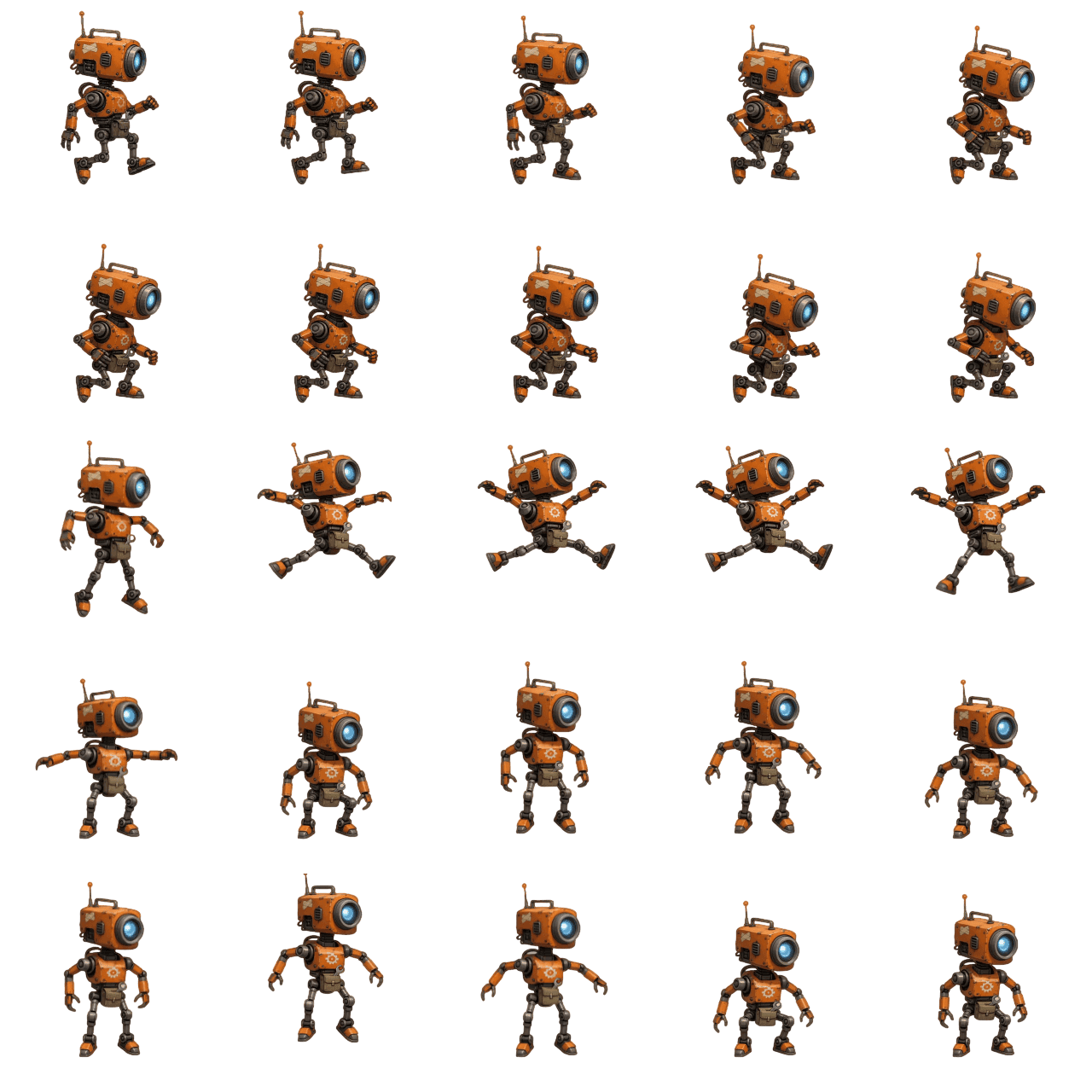
robot_jump.json — 2 of 25 frames
{
  "frames": { "0": { "x": 0, "y": 0, "w": 256, "h": 256 }, "1": { "x": 256, "y": 0 } },
  "meta": { "frame_size": [256, 256] }
}
idle, run and jump are ready in your project.
Two-minute setup
Connect AutoSprite to Cursor with a simple MCP setup. Add one configuration block and start creating game sprites directly from Cursor.
Sign in to AutoSprite and create an API key.
Open the API Keys pagePaste the JSON below into .cursor/mcp.json for one project or ~/.cursor/mcp.json for all projects.
Reload Cursor, go to Settings → MCP, and confirm AutoSprite shows a green status.
{
  "mcpServers": {
    "autosprite": {
      "url": "https://www.autosprite.io/api/mcp",
      "headers": {
        "Authorization": "Bearer YOUR_API_KEY"
      }
    }
  }
}
Replace YOUR_API_KEY with a key from the API Keys page. Keys start with vspk_.
New to MCP? It lets the Cursor Agent use AutoSprite directly. Once connected, the Cursor Agent automatically chooses from 33 tools to create and animate your game assets. Learn how AutoSprite MCP works.
Prompts
Use these prompts with your coding agent. It's as simple as that!
>Make me a repair robot and rig it in 3D with idle, walk and roll
>Create a neon ninja with a fast run animation
>Animate a young witch casting a magic spell with her cat
>Create a red pixel-art dragon with a fast run animation
>Animate a forest druid walking with a glowing staff
>Make my rpg character dance
Pro tip
A rule file in .cursor/rules/ is loaded into every Agent session in the project. Add a short art-pipeline rule and the Agent reaches for AutoSprite instead of dropping in another placeholder.
# .cursor/rules/art-pipeline.mdc
---
description: Art pipeline for this game
alwaysApply: true
---

When this game needs 2D character sprites or
animations, use the AutoSprite MCP tools
(create_character, generate_spritesheet) instead
of placeholder graphics. Save exports to
public/assets/ and read the JSON atlas before
writing any preload or animation code.
FAQ
MCP (Model Context Protocol) is an open standard that lets a coding agent call external tools. AutoSprite runs as a hosted MCP server over HTTP, so once it is connected the Cursor Agent can create a character, animate it, and export a transparent PNG spritesheet plus a JSON atlas — then write the code that loads them into Unity, Godot, Phaser, or another engine.
MCP tools only run in Agent mode — plain chat and inline Cmd-K edits will not call them. Also check Settings → MCP to confirm the server shows a green status; a red status usually means the Authorization header still says YOUR_API_KEY. Reload the window after editing mcp.json so Cursor re-reads it.
Both work. Use .cursor/mcp.json inside the repo when the whole team should get the server with the project (put the key in an env reference, not in git). Use ~/.cursor/mcp.json when it is your personal setup across every project.
Only what the Agent puts in a tool call — your prompt, and any image you explicitly ask it to upload. AutoSprite is a hosted HTTP MCP server: it does not read, index, or receive your codebase, and it has no access to your filesystem. Cursor writes the returned files into your project itself.
Try AutoSprite free in your browser, then add one line to connect the AutoSprite MCP to your coding agent. From there, the next character, animation, or game asset you need can be created directly from your task description.
Free in the browser — 15 credits a month, no card. MCP and API access are included with Pro at $29/mo. See pricing
Other coding agents